
Alec Hamilton writes about Arts & Crafts Churches – and chapels!
Just because it’s called Arts & Crafts Churches doesn’t mean my book (published by Lund Humphries in 2020) has no chapels in it. Far from it. But a book needs to have a snappy title – and, to be candid, most of the buildings are indeed churches. Nonetheless, chapels do figure – and this piece is about two of the most intriguing. Father and Son, if you like.
Compare and contrast.
In the 1890s ‘Arts & Crafts’ was rather a fashionable idea – posh, even. And some of the people who paid for new ‘Anglican’ churches then were not especially religious – there was quite a bit of conspicuous consumption: All Saints, Brockhampton was built for an American millionairess who almost certainly never worshipped there; St Mary, Great Warley was commissioned by a stockbroker in memory of his brother, its apse coated in aluminium foil – as dear as silver in 1904; Holy Trinity, Sloane Street was built for Lord Cadogan at a cost of £20,000, when perfectly good churches could be had for £4,000.
That sort of bling attitude did not quite accord with Nonconformist sobriety. Besides, Nonconformists were not always quite so rich as Anglicans – nor quite so given to show… except in the big mercantile cities – notably Liverpool. When commercial success created mountains of cash, and civic achievement demanded expression in tangible form, the Nonconformists let rip, with panache and pride.
Liverpool never looked to London – it never has. It looked to America – first in the slave trade, then in cotton and tobacco, then in emigrants. Liverpool looked to the world.
The robustly red-brick bulk of Ullet Road Church, Sefton Park (1896-1902) is a muscular demonstration of Liverpool wealth, independence of mind, and municipal braggadocio. It is (and was) no mere ‘chapel’, but a ‘church’ (that debate rumbled on), as well as a community centre and educational institute – at its centre, a shrine to the great men of Liverpool trade; and a library, meeting rooms and hall still used, up until lockdown, for local drama and toddler groups.
It started as a Puritan church near the Dingle in the early 1600s: the Dingle (where Ringo Starr was born a little later) was an obscure village two miles from the port. By 1688 they moved to the town centre. In 1727 they moved again, to a new chapel in Redcross Street. The congregation swelled, and included William Roscoe (1753-1831), the city’s MP 1806-7, famous for denouncing the slave trade in this, England’s premier slaving port.
The congregation was achingly respectable – between 1774 and 1779 they produced four of the city’s mayors. In 1810 there was yet another new chapel, in Renshaw Street – registered as a ‘Presbyterian Chapel or Meeting House’. At the opening, Revd John Grundy dedicated the new building to ‘the worship of the One and only true God the Father’ and pronounced it to be Unitarian.

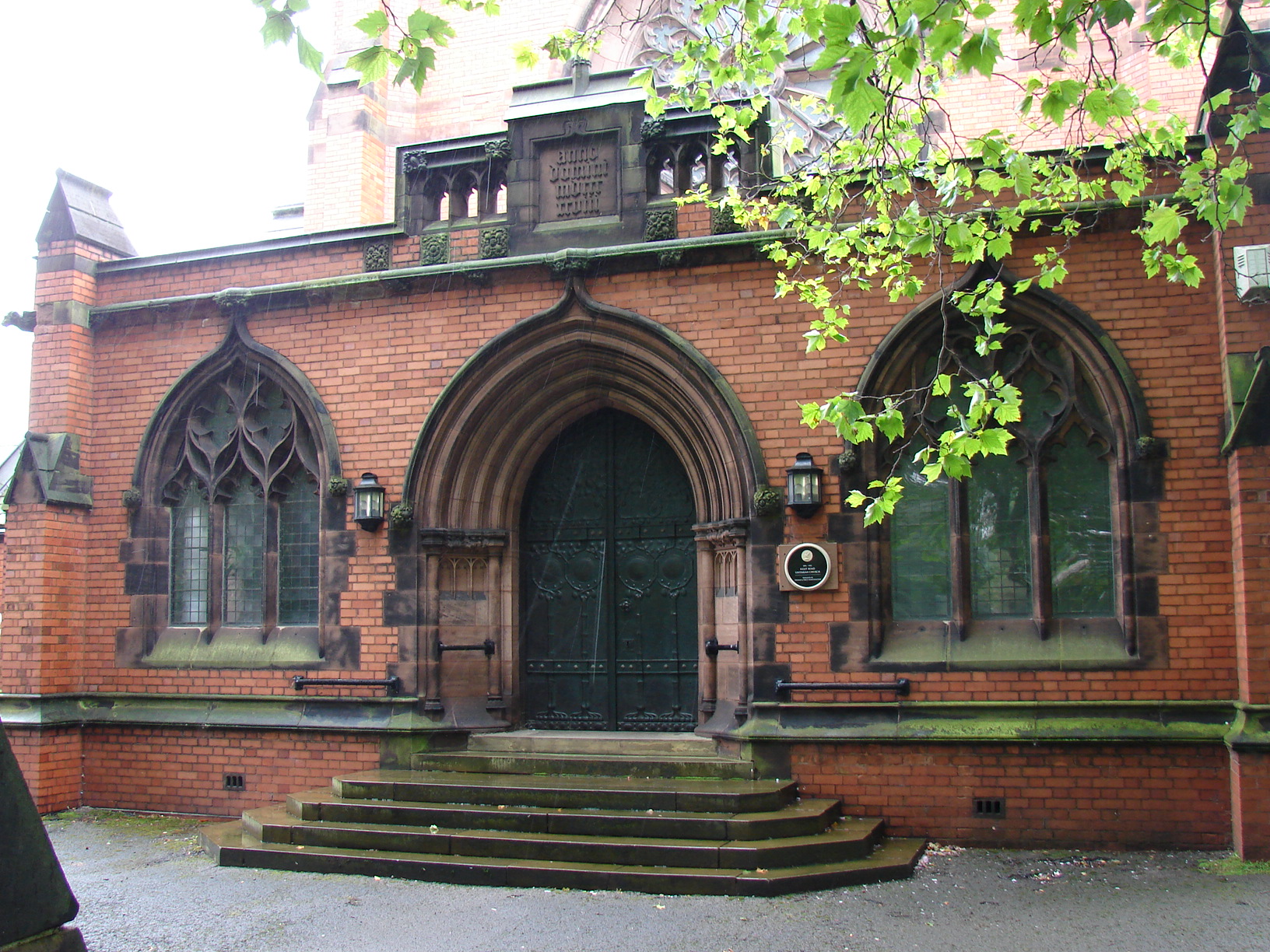


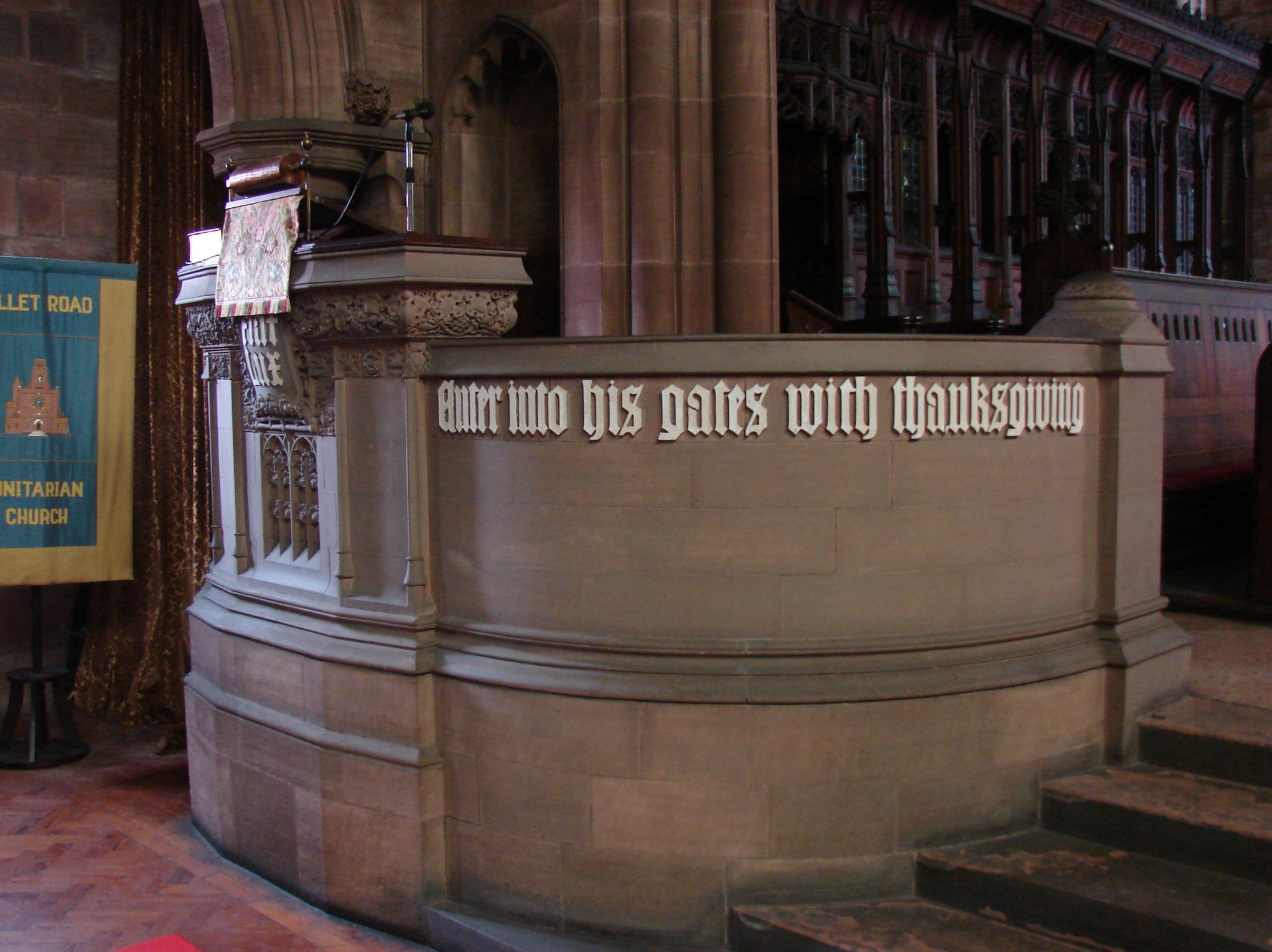

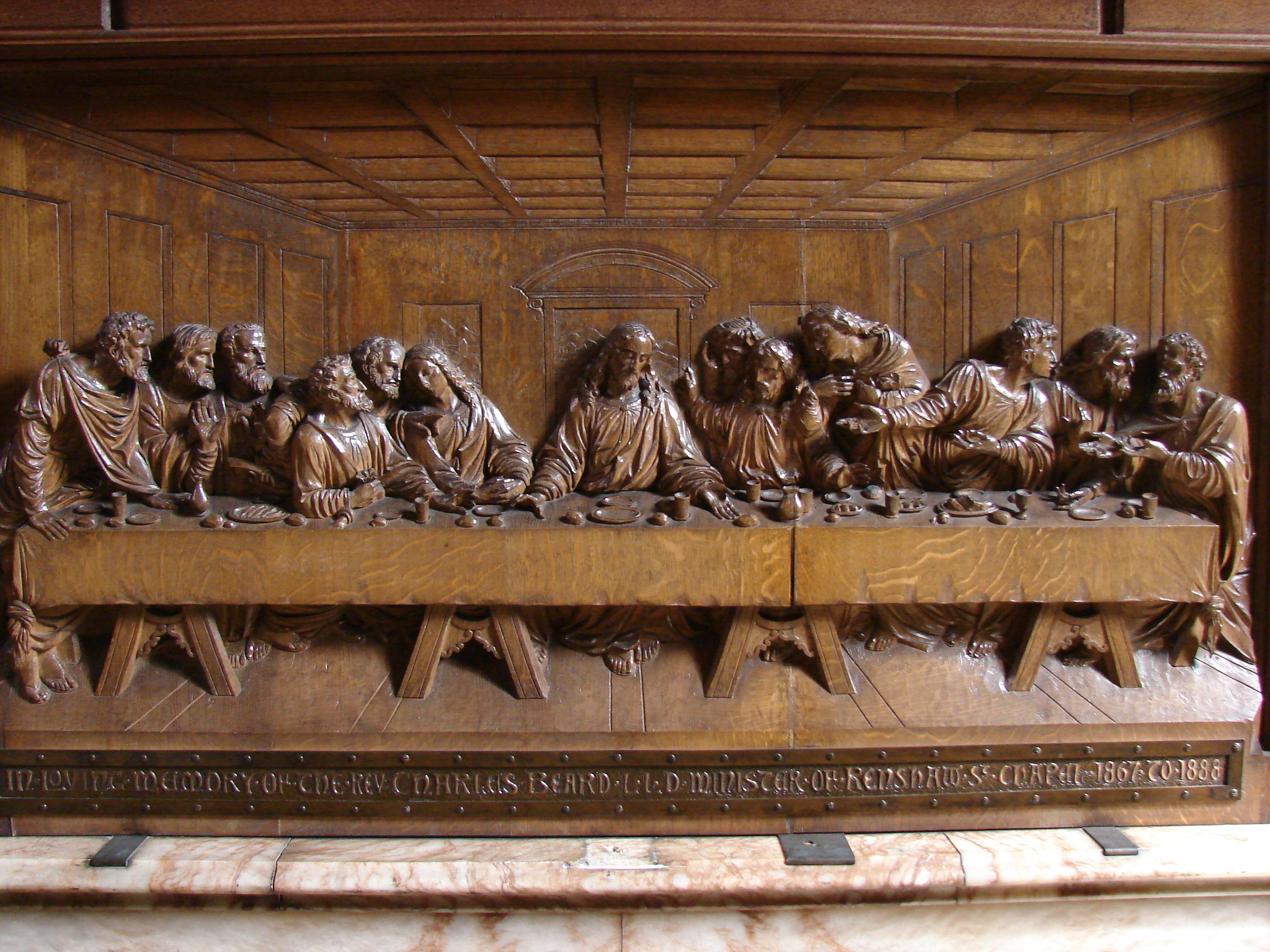


Photographic credits and copyright: Alec Hamilton
This startling twist took many in the congregation aback. But they swallowed their reservations. The boom swept on: in 1894 Renshaw Street was no longer quite the thing – now in the business district. Church Council minutes record: “it is desirable … the Chapel should be removed into a more residential neighbourhood.” Samuel G Rathbone offered a substantial parcel of land next door to his palatial Sefton Park mansion. Sefton Park was spacious and expensive – a 200-acre landscape with lake, lodges and gates, and mansions round the perimeter, many on an heroic scale.
Not everyone was happy with the move. William Rathbone MP wrote a letter: it would take them away from “the great mass of the people from among whom …. the first Christians came… unhardened by ease and self-indulgence.” One of the early ministers, Revd J Hamilton Thom, deplored the siren allure of “more impressive church architecture.”
But the men of the moment, Charles W Jones (?-1906?), Treasurer of the Council, and George Holt (1825-96), ploughed on, and fears were extinguished. Both men were partners in the powerful shipowners Lamport & Holt: money talks, even among Unitarians. Jones and Holt were members of a clique of now wealthy Unitarian families, interlinked by business and marriage. The Liverpool Daily Post article on the opening of the new church, May 1899, lists the families: “Brunner, Tate, Rathbone, Thornely [sic], Holt, Jevons, Roscoe, Gair, Melly and Bright.”
John Brunner (1842-1919) founded Mond & Co in 1874 – which became ICI. Henry Tate (1819-99) made his fortune from West Indies sugar, and the invention of the sugar cube. Henry Arthur Bright (1830-84) was a successful trader with Australia, a hymnographer, bibliophile and friend of Nathaniel Hawthorne; and he was related through his mother to the Joneses.
As the influence and affluence of the congregation grew, unfamiliar ideas began to take hold. Ullet Road contains a Last Supper reredos (by Martyns of Cheltenham), surmounted by a cross (though not a crucifix): a tad unusual for Unitarians. In 1898 the church’s mixed choir was disbanded and replaced by a men and boys’ choir, in surplices. There was a lengthy dispute about the introduction of a formal liturgy, with appropriate service book; a bespoke Hymn Book was produced. In 1899 there was a debate about the name of the new church: “Ullet Road Chapel” was rejected in favour of “Ullet Road Church”, though only by 17 votes to 13. In 1903 it was even proposed that the “minister be authorized to provide himself with a curate.” There were “footstools” and kneeling at prayers. Oh dear, oh dear!
Respectability was expressing itself in increasingly establishment ways. Not surprising, then, that Ullet Road looks more Anglican than Nonconformist: the Minute Book proudly called it “one of the most beautiful churches in Liverpool.”
The materials were certainly of the best, and though the exterior is in tough scarlet Ruabon brick, the inside is lined in warm pinky-purple Runcorn sandstone. There are choir stalls with elaborate neo-Gothic architectural niches. The Daily Post reported, “every hinge and handle, every bit of tracery and carving, is pleasing to the artistic eye.”
The architects were Thomas Worthington & Son of Manchester, the Unitarian architectural practice. Thomas (1826-1909) designed at least six hospitals, Unitarian churches at Gorton, Eccles, Hyde and Altrincham, and Harris Manchester College, Oxford. By 1895, the bulk of the work was being carried out by his son Percy (1864-1939), instrumental in setting up a school of architecture at Manchester University; he too designed a hospital.
The artist-craftsmen who worked at Ullet Road were thoroughly Arts & Crafts in outlook and sympathies. Richard Llewelyn Rathbone (that name again) was a member of the Art Workers Guild from 1892: he made the massive bronze doors to the north, west and south.
In 1900 Gerald Moira (1867-1959), a member of the Art Workers Guild from 1898, was commissioned to decorate the new library which adjoins the church. He painted allegorical murals on the ceiling, and coloured decorative bas reliefs below. He had studied painting at the RA Schools, and showed at the RA from 1891. His first major public work had been friezes for the Trocadero restaurant in London (1896). The work at Ullet Road occupied him for two years. The figures on the ceiling include Moses, Milton, Aristotle, Galileo, Shakespeare, Plato, Homer, St Paul, Gutenberg and Leonardo. And the donor, Sir John Brunner.


Photographic credits and copyright: Alec Hamilton
In 1906 the most ‘Arts & Crafts’ object appeared: a movable font by Ronald Potter Jones (1876-1965), a member of The Century Guild, and of the Art Workers Guild from 1909. He became the leading Unitarian architect of the early 20th century. He wrote Nonconformist Church Architecture (1914), and designed Unitarian churches at West Kirby and Cambridge (both 1928).
As if to demonstrate the Arts & Crafts credentials of the font, he worried about the man who was making its panels: “Like all these artistic workers, he is always very short of money.” Jones himself was less worried about money: he was the heir of one of the powerful shipping families, and son of Ullet Road’s (late) Treasurer.
The church (no, not chapel) is at once old-fashioned – big, ungainly, full of stained glass and enormous stone and woodwork – and new: Moira’s almost pantheistic murals, the Arcadian simplicity of its 1905 Hall, the complex and ethereal font. The Arts & Crafts influences overlay the church’s excessive dignity with a touch of youthful light-heartedness. It seems, in consequence, neither quite city magnificence, nor yet suburban ease.
Almost as soon as Ullet Road was finished, the Unitarians started afresh across the Mersey, at Wallasey. And in a new direction entirely.
Unitarianism was new to the Wirral – from about 1888, and they started with a tin tabernacle. In 1896 the Chairman of the Church Committee died: his widow, Martha Elam, gave money for a proper new church – Wallasey Memorial Unitarian Church, Liscard. She appointed Edmund Ware (1852–1934) and Edmund Rathbone (1863–1924) as her architects before she had so much as selected a Building Committee. Possibly because they had recently designed the school hall at nearby Egremont Baptist Church, Wallasey (1896).
Rathbone and Ware were committed Unitarians, and well connected. Rathbone’s uncle was a Liberal MP, who determined “at an early age to devote an ever-increasing proportion of his income to public objects“. Rathbone’s father knew both Ruskin and Morris: he was responsible for Liverpool’s Walker gallery buying a number of works by the PRB.
Edmund Rathbone was the Liverpool representative of The Century Guild. He organised the 1896 Liverpool ‘Aesthetic Fair Loan Art Collection’ with works by Rossetti and Whistler. And he ran The City Beautiful Wayside Café, a meeting place for Liverpool’s artistic elite. He wrote a booklet on ‘Humanity and Art’. And he was a poet: in 1907 he wrote, “let me make pretence, however small | Humanity to serve, and citizen to be!” His brother, Harold (1858–1929) founded the Della Robbia pottery company in Birkenhead; it was his cousin, Richard Llewelyn Rathbone, who had made the doors at Ullet Road.
The bold magnates who had paid for Ullet Road had spawned an un-commercially artistic generation. So often the way.
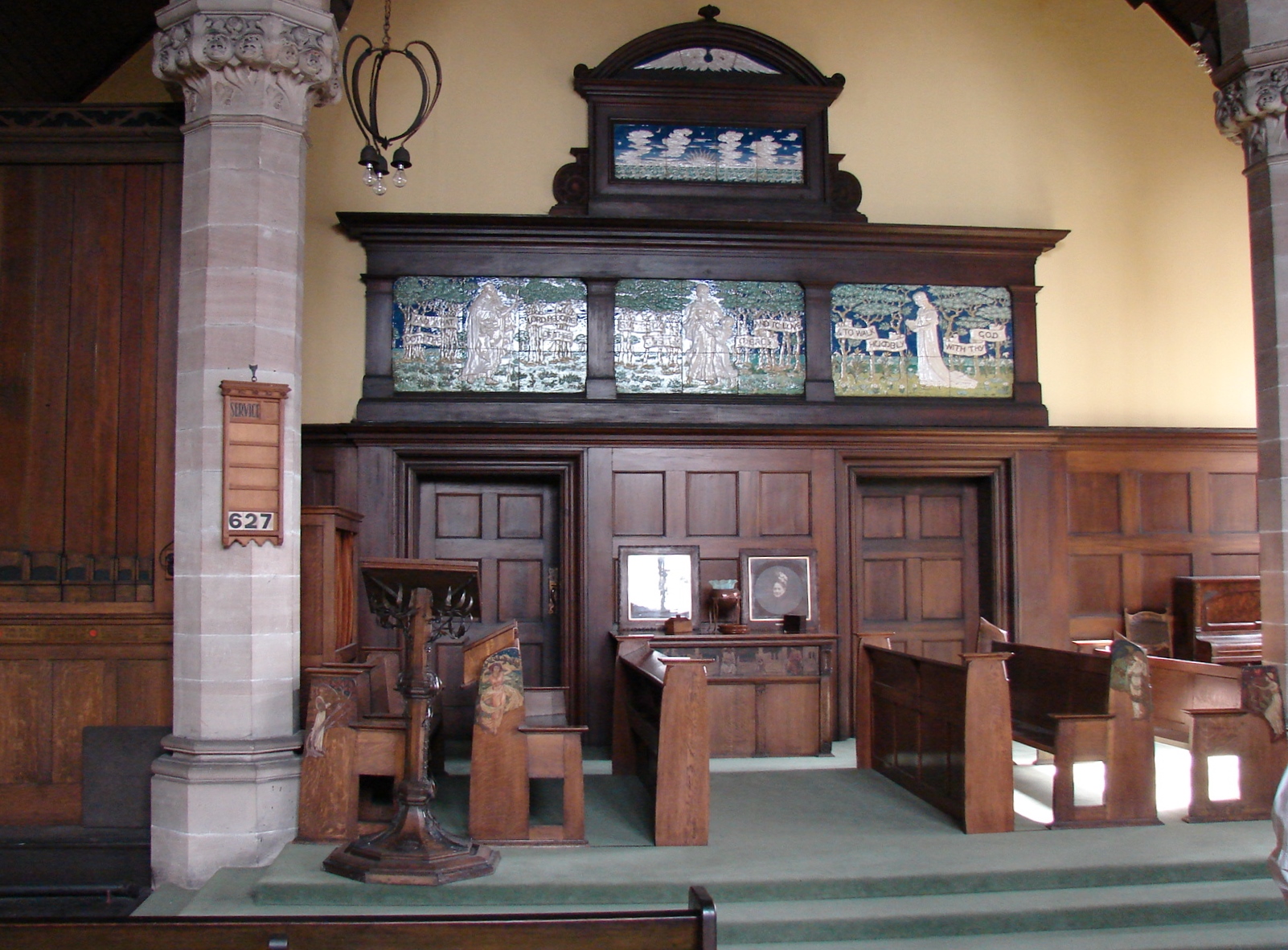

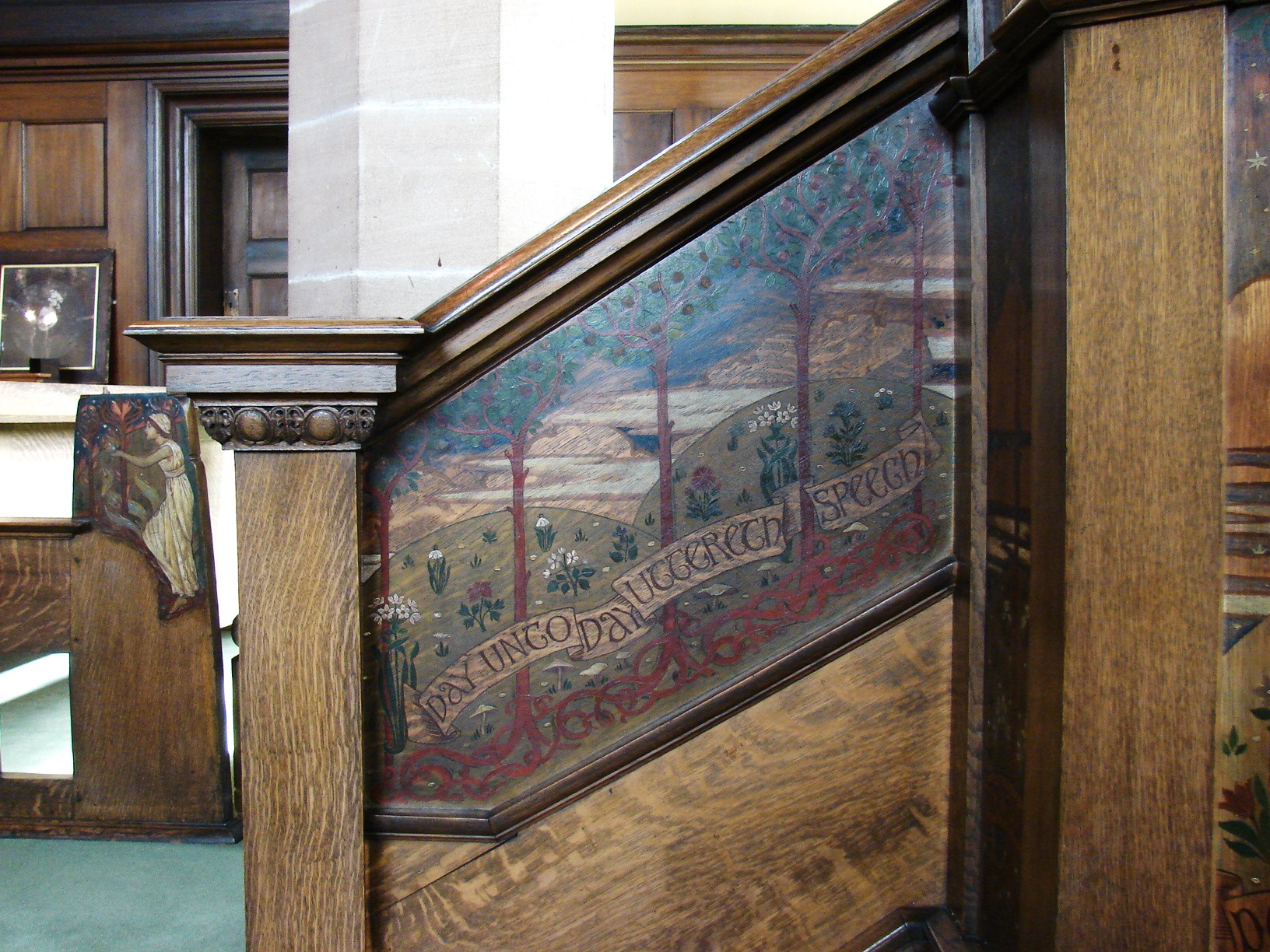

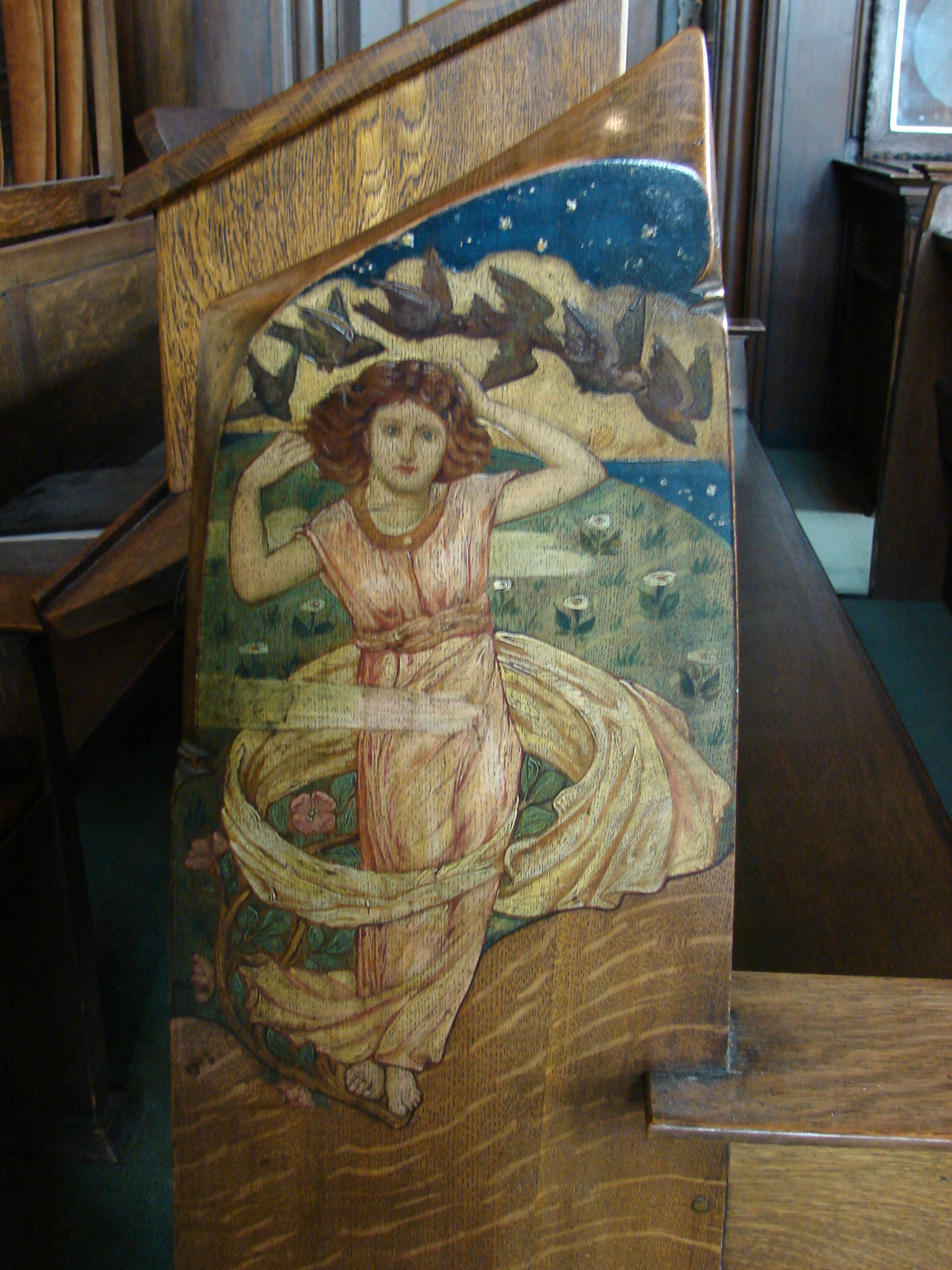
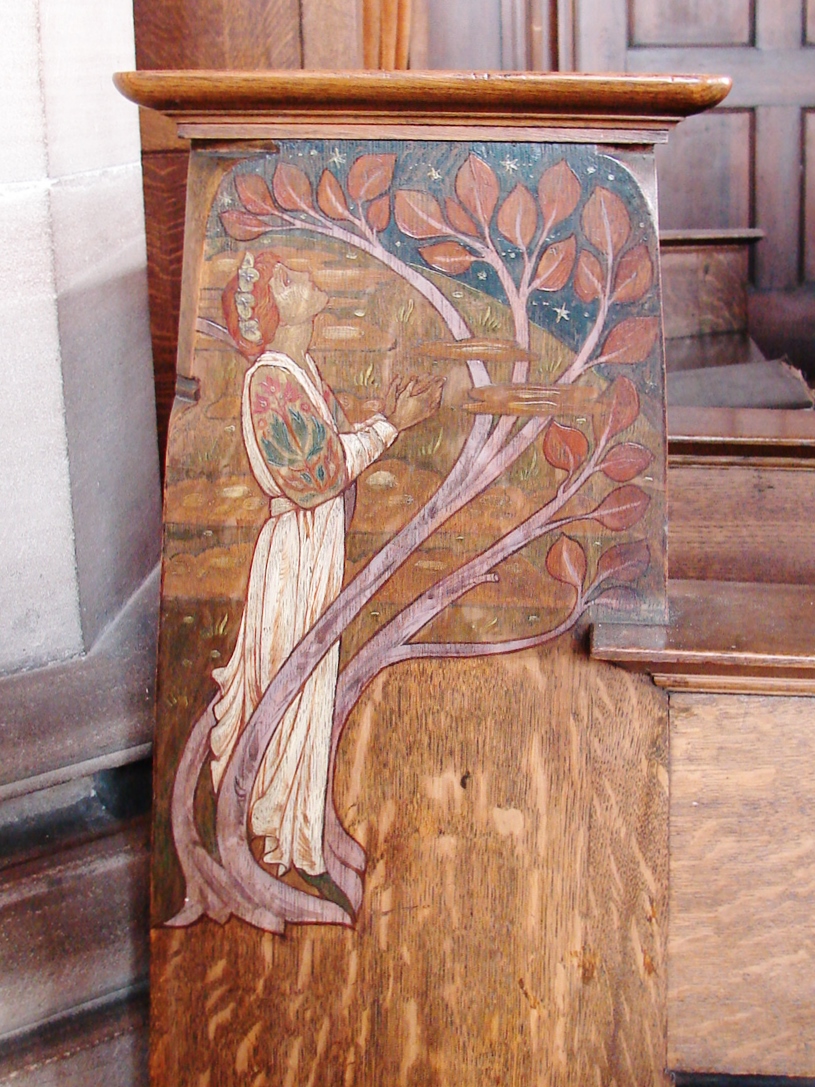


Photographic credits and copyright: Alec Hamilton
The artistic connections at Wallasey were impeccable. The decorative ironwork is by Walter Gilbert (1871-1946), who co-founded the Bromsgrove Guild. The coppered bronze hanging light fittings are his, too (1899) as is the sinuously foliaged lectern.
Benjamin Creswick (1853–1946) of Birmingham, also of the Bromsgrove Guild, made the figures sculpted in the porch – not the four Evangelists, but, as befits a more artistic worldview, perhaps, Meditation, Eloquence, Devotion and Music.
The bench ends, pulpit and communion table were painted by Bernard Sleigh (1872-1954), also of the Bromsgrove Guild. It may seem odd to have his PRB ‘stunners’ on pew ends, but it was not intended to shock, rather to reflect a matter-of-fact view of connections between heaven and earth. (Sleigh’s religious inclinations are not known – but he did believe in fairies.) The panels on the pulpit show Intellectual Truth, Moral Goodness and Spiritual Beauty; on the choir stalls, the Four Elements; on the table, Christ in Majesty, with Faith and Charity on either side.
The panel above the altar, fulfilling in part the office of a reredos, is from the Della Robbia Pottery – the largest piece they ever made. The congregational seating was originally stained green – another Arts & Crafts motif.
It is hard to disentangle now, but the younger generation at Wallasey was possibly at variance with the older at Ullet Road, and more forward-looking. The contrast with Ullet Road is striking – there gravitas, here levity; there hints of conventional Anglicanism, here purposeful unorthodoxy. Employing the Bromsgrove Guild, in particular Sleigh and Gilbert, to decorate the interior, expressed not only the new generation of Unitarians’ awareness of European artistic ideas, but a commitment to liberal, even humanist values.
It strikes a luminous chord yet. (Wallasey is in the loving and conscientious hands of the Historic Chapels Trust, currently under the tender wing of the Churches Conservation Trust.)
All Saints Church, Brockhampton, near Ross-on Wye, Herefordshire, thatched roofed :
Herefordshire Archives.
ref. R45/24, Papers of Rt. Rev. John Percival. Forms and orders of service : 1902 consecration of All Saints, Brockhampton (2 copies) : 1902 Coronation of King Edward V11 and Queen Alexandra.
………………………………………………..
Extra, not including above research :
To view replica thatched church in Japan within protective surround cover, go to :
http://www.allsaintsbrockhampton.org/replica-in-osaka-japan/
To view original church : http://www.allsaintsbrockhampton.org
Kind regards,
Ray & Marie.
Holy Trinity Church, Sloane Street, London.
London Metropolitan Archives :
ref.P74/TRI, collection from 1832 to c.1888, continuation 1889-1980, baptisms, marriages, church plans, maintenance papers, etc, to include bombing repairs WW2. ref. P74/TRI/025/02-03, grant of faculty, remains of Catherine Mackenzie to be placed beneath interior of church floor, year 1923.*
ref. P74/TRI/042, faculty for remains of B.J. Turner to be placed beneath church floor , 1947.*
Other documents.
*Ashes, also other person(s) in documents.
Kind Regards,
Ray & Marie (Æ).
…
Ainsworth (Cockey Moor Unitarian/Presbyterian Chapel ).
The Chapel on some O. S. maps is termed firstly ‘Unitarian Chapel’ then ‘Presbyterian Chapel’, to the right being Cockey Moor, then mainly a woodland area. The chapel can be located on top portion of maps, junction of Well Street into Knowsley Road, below chapel is Oaks Nook and above chapel is Windy Harbour.
O.S. maps, 1844 to 1847, this one published in 1850, other map c.1892/3.
Enlarge to view via:
https://maps.nls.uk/view/102344024
https://maps.nls.uk/view/126520508
Bolton Archives & Local Studies:
ref. NULI/1-13, North & Lancashire Unitarian Mission, documents to include Ainsworth Presbyterian Chapel.
ref. ZBGH/315, restoration of roof, painting and decorating, 1911 to 1913, Ainsworth Unitarian Chapel.
ref. ZAL/182 and 150, to include a Plan of Ainsworth Cockey Chapel, May 1807.
Kind regards,
Ray & Marie.
Additional.-
Lancashire Archives :
ref. QSP/494/17, Ainsworth — conventide at Cockey Chapel, c.1678-9. *
* Unitarian/Presbyterian verification re-viewing document needed.
ref. UAI 1, Trust Deed, etc., Robert Aspinwall of Ainsworth, yeoman, to the Trustees of the Chapel, building and land in Ainsworth. Cockey Moor Unitarian/Presbyterian Chapel.*
*precise date to be checked, possible period 1633-1793.
ref. UAI 5, Abstract, properties, 1633-1793, to include Cockey Moor Unitarian/Presbyterian Chapel, Ainsworth.
Other documents.
Kind regards,
Ray & Marie (Æ).
West Kirby, Brookfield Gardens, Free Church-Unitarian, Wirral.
Services first held in the Public Hall and then in Lower Tynwald/Tynwold Hall, West Kirby, meetings c.1906, then first Tin Church, Grange Road, built in 1910. New Church built 1928, Brookfield Gardens.
Cheshire Archives & Local Studies :
ref. EUC 5 (131 files), West Kirby Unitarian Chapel/Church, from c.1909/10 to 1928, then continuation 1928-1969.
Sample :
ref. EUC 5/17, The Tin Church, collection of documents, etc., 1909-1927.
ref. EUC 5/17/8, Photo of first church, the Tin Church, n.d.
ref. EUC 5/29/30,31, Photos of ministers and members in 1950.
ref. EUC 5/29/33, the 50th Anniversary Service Programme (printed) May 1960.
ref. EUC 5/29/34, 35, Anniversary Celebrations, newspaper cuttings, June 1960.
Kind regards,
Ray & Marie. (Æ).
Wallasey Memorial Unitarian Church, Liscard.
https://maps.nls.uk/view/114581032
On the above Link is a O.S. map revised 1909 publish in 1911 and for Liscard area the Memorial Church can be located next to a Concert Hall on Manor Road, (enlarge the map to view).
Cheshire Archives & Local Studies :
ref. EU 10, Wallasey Memorial Unitarian Church, Liscard, registers and various documents 19th to 20th century.
Sample : baptisms 1893-1970, marriages 1897-1974 and some burials 1926-1964.
Kind regards, Ray & Marie.