
From Dance Hall to Church: 100 years of 114 North End Avenue, Portsmouth
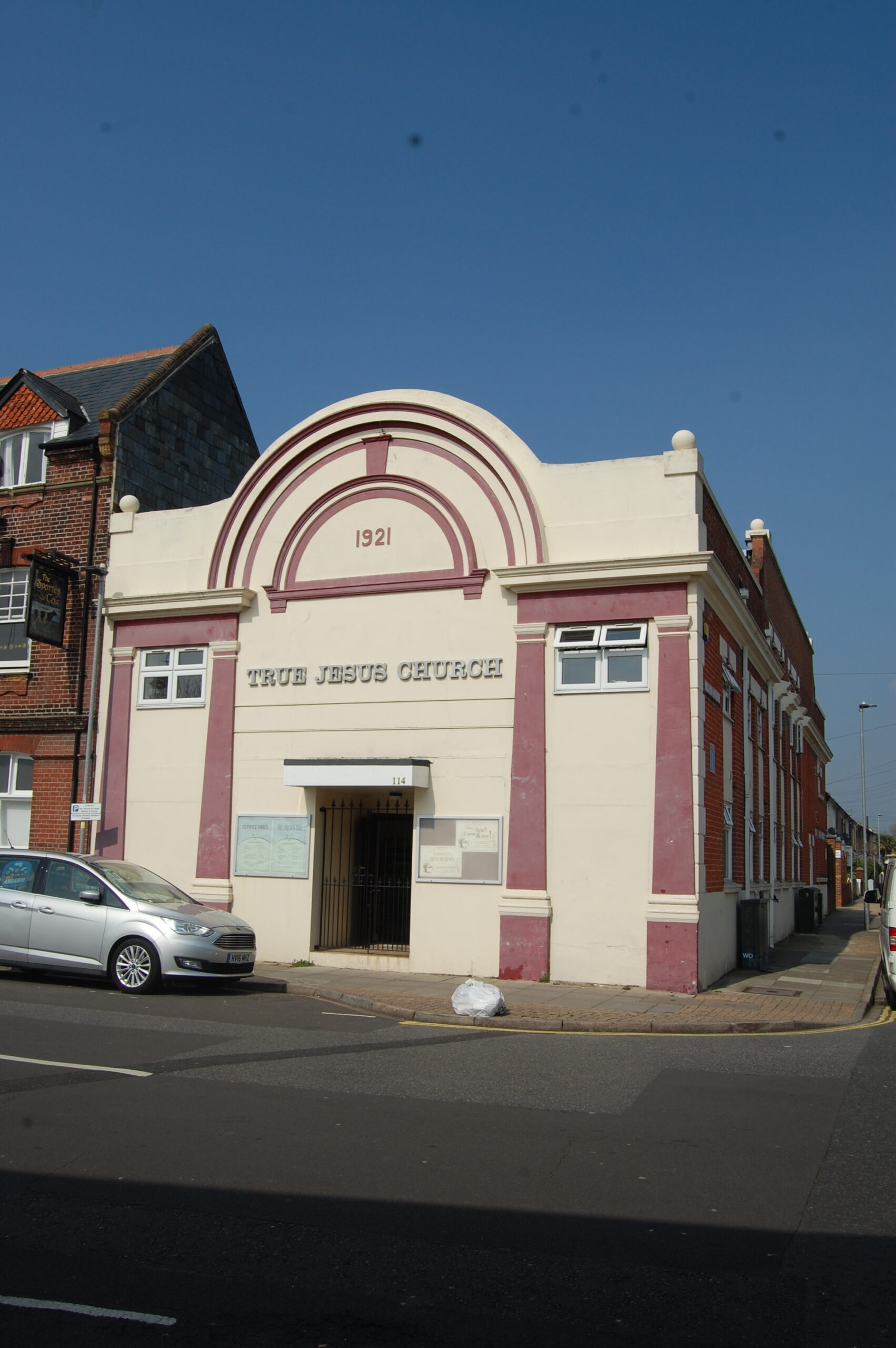
The True Jesus Church is an independent Pentecostal Church founded in Beijing in 1917. There are more than 1 million adherents in China, and congregations have been established by the Chinese diaspora in more than 50 countries. Britain’s first was founded in Newcastle-upon-Tyne in 1976, and there are ten active congregations in England and Wales; but none occupy such an interesting building as that owned by the Portsmouth congregation. Having previously worshipped in a Chinese restaurant, in December 1985 they bought and registered 114 North End Avenue – a former dance hall built exactly a century ago, as proudly proclaimed on the tympanum. The dance hall closed in 1940 but escaped the city’s wartime destruction, perhaps because of its obscure, backstreet location. Shortly after World War II it was converted into a garage, and it was still used as such until the True Jesus Church purchased it in 1985 – although it was not until 1989 when it was fully fitted out as a church (initially only four rooms of the building were registered as a place of worship).
The building makes a bold statement on a street corner in a mostly residential area. It has two storeys with an attic level above, a three-bay façade and a long red-brick east elevation. A strongly projecting architrave wraps around both elevations, giving some distinction to the east wall which is otherwise plain with UPVC windows and door. Four of the upper windows on this side break through the architrave into the attic level, which is also marked by a half-storey extension to the brickwork with curved corners and topped with ball finials. The door and taller windows are off-centre, giving this side a strange appearance. The front (south) face is much more regular, broadly Classical in style, with a simple central entrance and two small windows placed high up. Flanking these are paired pilasters which project slightly and taper from ground level up to the architrave. Above this is a semicircular pediment with ball finials at the corners; in the tympanum, in a slightly recessed panel, is the date 1921. The main façade and the window surrounds are painted white, but details such as keystones and pilasters have been picked out in a dark red colour.
Coincidentally, all four of Portsmouth’s Pentecostal churches use second-hand buildings. As for the others: the Elim Church bought and converted a former cinema in 1931 (a very early example of this practice); the independent Jubilee Church bought and took the name of the former Jubilee Primitive Methodist Chapel; and the King’s Church (Assemblies of God) – originally the Hebron Christian Fellowship – moved from a billiards hall to a snooker hall before acquiring a redundant Anglican church in 2014!
Author: Matt Davis