
The chapel in Bath Street, Huddersfield, must have the most unusual chapel history in the whole of Britain. Although for part of its history it was home to religious congregations, it was built as the Huddersfield Hall of Science by and for the followers of Robert Owen in 1839. The Owenites believed that Man is good by nature but corrupted by his environment. The solution to the problems of mankind therefore lay in leaving behind the evil influences of what was termed the ‘Old Immoral World’ and settling instead in Communities of United Interest where all influences would be benign and the secular millennium could be commenced in the ‘New Moral World’. This made sense to a generation of workers growing up in early industrial society with its dirt, drink, poverty, lack of education and exploitative working conditions, but among the other evils of present society were the false teachings of religion on such matters as original sin and redemption through faith. The Owenites were therefore opposed to, and opposed by, Christianity, especially that of an evangelical variety such as flourished in a town like Huddersfield. Yet at the same time the Owenites assumed in the way they organised themselves the form of a religious sect, with their meeting places (chapels), ‘social’ hymns and secular ceremonies, Sunday schools, anniversaries, fund-raising bazaars, naming ceremonies for infants (baptisms) lectures (sermons), study of ‘sacred’ texts (written by Robert Owen) and so on which served in functional terms the cultural needs of a chapel congregation.
To promote his cause, Robert Owen established his Association of All Classes of All Nations in 1835 and two years later his National Community Friendly Society to promote a community as an experiment to ‘prove’ the truth of his message. When a community was begun in Hampshire in 1839 these societies were amalgamated to form the Universal Community of Rational Religionists, or Rational Society for short. The Owenites themselves, as advocates of Owen’s ‘social system’, were known as Socialists. Some of their lecturers controversially took out preaching licences to gain legal protection. In all during the next few years after 1837 some sixty branches were formed throughout the country, chiefly in London and the textile districts of Lancashire, Cheshire and Yorkshire. The sixth branch in the whole country, and the first in Yorkshire, was in Huddersfield. Early meetings took place in what were called Social Institutions, often no more than hired rooms, but the bigger branches leased or built larger premises which they dignified as Halls of Science. Although there were several of these, the most famous being that in Manchester (the building was sold in 1851 to become the city’s first Public Library before being demolished to make way for the Free Trade Hall), the one built in Huddersfield is the only one to survive. In the later nineteenth-century the Secularist movement continued the legacy of anti-Christian Owenism and had its own halls (notably the one in Humberstone Gate, Leicester), some of which were called Halls of Science, but the Huddersfield hall is a unique survival of this earlier phase. As such it has been Grade 2 listed since 1978.
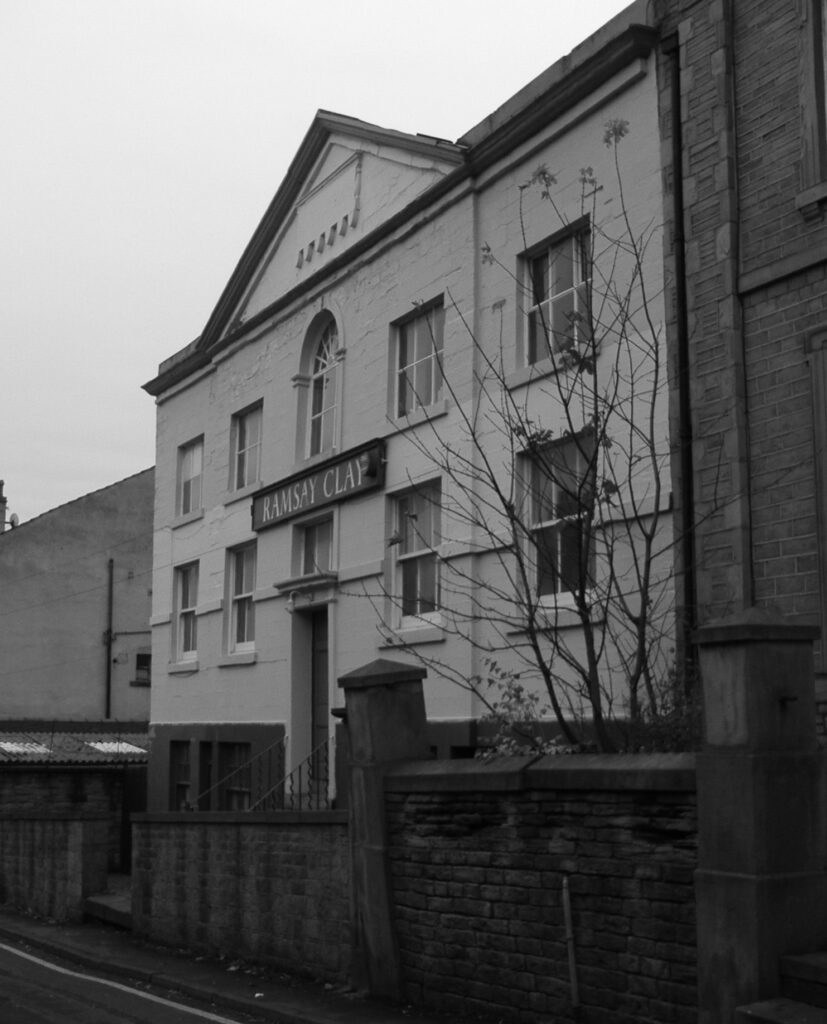
To begin with, in the Autumn of 1837 the Huddersfield Socialists rented their premises from the landlord of the George and Dragon on Manchester Street. Here the cause prospered and the room was soon over-full, so when the landlord was threatened with the non-renewal of his licence they began looking for alternative premises. This was not easy. The landlord of the first building plot they acquired broke his contract; when another plot was found the builders broke their contract; and their local lecturer was dismissed by his employer, who was a Wesleyan. Finally they secured a site just outside the town centre where there had been a small spa – hence the later name of the new street. About fifty local Socialists began to dig the foundations in March 1839, the foundation stone was laid on 2 April, the roof was on by 10 July and the hall was opened on Sunday 3 November 1839.
The building is described in the Listing as:
York stone, the facade dressed, the returns random-coursed rubble; three stories (formerly two stories but Hall divided horizontally without affecting fenestration); central pedimented block slightly advanced; five sash windows with glazing bars, the central with arched head, plain architrave, extrados and keystone; plain rectangular panel the pediment with apron-pieces and defaced inscription; central doorway at first floor level with plain architraves, slight cornice hood, rectangular barred fanlight and 6-panelled door; stone steps and later wrought iron handrails; ground floor has two plain doorways with panelled doors and fanlights; string course; blocking course, parapet and moulded cornice; slates.
The building was almost square, 17 x 15 yards, and 30 feet high, with a school room in the semi-basement and a main hall on the first floor approached up a steep set of steps. There was a musicians’ gallery over the entrance. Three of the windows held stained glass, executed by a Salford plumber, Joseph Smith, who did the same for the Manchester Hall of Science and the main community building, Harmony Hall, in Hampshire.
All this was made possible because the local leadership included a number of men who, if not wealthy, could be described as prosperous workmen and skilled artisans, led by George Brook, a foreman dyer (who lost his job on account of his Socialism and set up his own business). Another self-employed Socialist was Reid Holiday, a chemist whose business was eventually to grow into the dyestuffs division of ICI. For the most part the original managers included clothiers and others in the textile trades, shopkeepers, a tailor, a joiner, a shoemaker and a warehouseman. For the most part they depended on their members and paying Sunday ‘congregations’ to service their building loans, and when the movement began to decline after 1842 the future of the Hall was thrown into doubt. In 1844 the Wesleyans offered to buy the hall for use as a schoolroom but their offer of £1,000 was considered too low and an agreement was reached with the local Chartists – radicals who campaigned for universal manhood suffrage – to share the premises, but the Chartist were also in decline after 1842 and in 1847 the decision was made to relinquish the hall.
In August 1847 it was leased to the local Unitarians for use as a chapel but in 1853 they built themselves a Gothic chapel just round the corner in the new Fitzwilliam Street and the lease was sold to the Baptists. Baptist churches, both Strict and Particular, were strong in the Huddersfield area, but mainly out of the town and among the handloom weaver communities of the hills and valleys to the west. But as industry moved into factories in the valley bottoms nearer the canal and then the railway, so the Baptists sought out a town centre chapel, and they occupied the former Hall of Science from April 1855 until April 1878 when they too opened a new chapel nearby in New North Road, though they retained the building as a school until 1882. The building was then acquired by Peter and James Conacher, internationally famous organ builders, as an extension to their main works in the town to serve as an erecting shop and saw mill – they supplied several local churches and chapels including the parish church. They retained the premises until 1902 when the chapel briefly returned to mainstream religious use as the Railway Mission before becoming a warehouse in 1919 for Gris Brothers, Shoddy Merchants. Since 1963 it has been occupied by Ramsey Clay, painters and decorators, as their paint and equipment store.
The interior shell of the hall is still recognisable for what it was, except for the addition of a part mezzanine floor in the main hall and boarding over what was once described as a ‘very richly ornamented’ ceiling, though the stained glass has gone. In its present, secular and run-down state the building is shadowing, in its old age as in its youth, the history of many a more conventional chapel. Bath Street is less than a five-minute walk from the railways station; both it and the Unitarian (now Polish Catholic) chapel were viewed from the outside by the Chapels Society on their visit to Huddersfield in 2008.
Further reading:
Alan Brooke, The Hall of Science. Co-operation and Socialism in Huddersfield, c. 1830-1848, Honley: Workers’ History Publications, 1993.
Edward Royle, ‘Huddersfield and the Secularist Tradition: the Huddersfield Secular Society and Sunday school’, pp. 199-217 in Learning and Living. Essays in Honour of J. F. C. Harrison, ed. Malcolm Chase and Ian Dyck, Aldershot: The Scolar Press, 1996.