
Matt Davis takes a look at a neat little chapel in his home town…
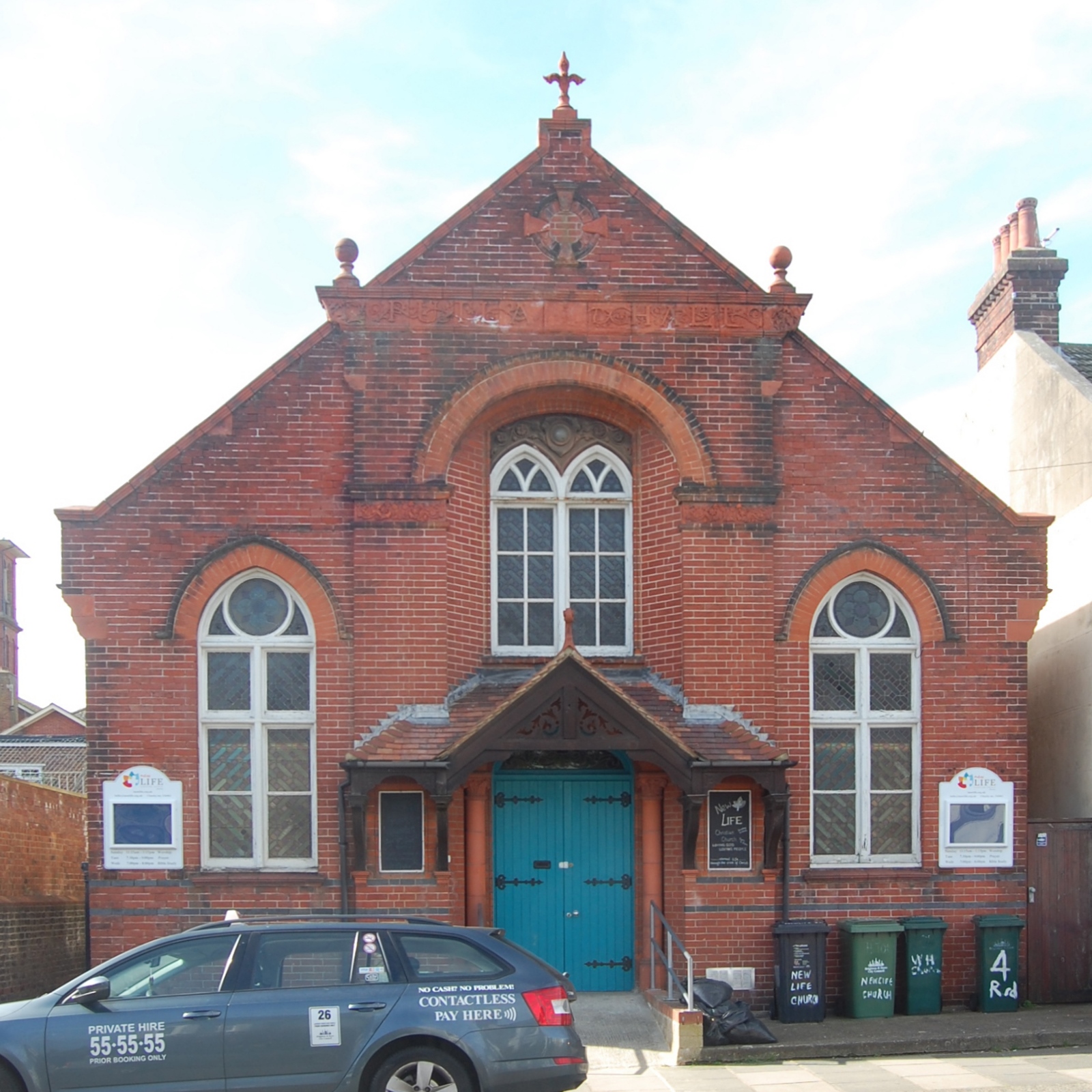
Poets Corner is a densely built network of terraced streets north of Portland Road in what was originally the parish of Aldrington, annexed by Hove Borough in 1893. In the heart of the area can be found an attractive little chapel – its original name, Rutland Hall, picked out in fancy terracotta letters (although the ‘N’ and the ‘D’ have been missing for many years!). Its present congregation have been using it only since 2008; but to tell its story properly, we must go right back to 1683 and to Hove’s noisy neighbour, Brighton, where a connection can be traced to that famous resort’s oldest Nonconformist place of worship. Other connections can be traced as well: to two of the most interesting and prolific local firms of architects, to various characters from local religious history, and to several other local churches past and present – proving as always that no church or chapel can really be considered or understood in isolation.
Brighton was a modest fishing village in the late 17th century, growing slowly in importance but of little significance beyond its local area. The four-street layout with narrow streets and connecting passageways (locally ‘twittens’) has been preserved for the most part and now forms ‘The Lanes’, a tourist-friendly zone of small shops and restaurants. In 1683, on one of the little streets, Union Chapel was founded for a varied group of Protestant Dissenters, as they were known at the time – modern denominational labels having not yet developed. By 1823 it was a Congregational chapel, and in that year some members established a Sunday School in Hove, which was then a tiny village, in a building owned by John Vallance (after whom the Vallance Estate, an area of good-quality Victorian housing, was later named.) A church developed from this, and in 1870 Cliftonville Congregational Church was built at the top of Ventnor Villas. It is now known as Central United Reformed Church and is one of six extant churches of that denomination in what is now the City of Brighton and Hove.

In turn, Cliftonville founded a daughter church in the rapidly developing parish of Aldrington. Rutland Hall was built in 1900 on Rutland Road, a recently developed side-street off Portland Road: the first houses there were built in 1894. A typical small turn-of-the-century chapel, it is given some distinction by the terracotta detail on the façade. It cost £3,500. The architect was William H. Nash, a local man who was responsible for a very similar looking mission hall on Sutherland Road in Brighton in 1893. Rutland Hall was built on the initiative of William Allin Hounsom and Ambrose Spong. The latter was the minister at Cliftonville Congregational Church for 36 years from 1872, and he bought and donated the site on Rutland Road; Hounsom, a close friend, lived nearby and was a longstanding member at Cliftonville, as well as a major landowner, a Justice of the Peace and a ‘stalwart figure in Congregationalism in Sussex and beyond’ (a description taken from The First Ten Years 1938–1948: The Story of the Hounsom Memorial Congregational Church, Hove, Sussex, published in 1948.)
In 1937, the Sussex Congregational Union decided to reach out to another rapidly developing residential area in Hove – the Hangleton estate. Concerned that no Nonconformist denomination had yet provided a chapel to serve this large area, it was decided that a Congregational church should be built there as soon as possible, and that Rutland Hall should be sold to help finance it. The chapel closed in December 1937 and was sold for £2,000; worshippers joined either the Cliftonville chapel or the new Hounsom Memorial Church, named after William Allin Hounsom (who had died in 1934). This church remains in use today as part of the United Reformed Church. It was one of many architectural works by Brighton-born John Leopold Denman, whose stylish and neatly detailed buildings and impressive pubs can be found across the city and more widely in Sussex.
The purchasers of Rutland Hall were an assembly of Open Brethren who had met in a hall nearby on Connaught Street since, coincidentally, 1900. Retaining the name ‘Rutland Hall’, they registered the chapel for their use in December 1937. The assembly continued to meet for the next 70 years but faded away by 2008 – at which point another congregation came into the picture. Stoneham Road Baptist Church, which served the Poets Corner area, had been founded in 1904 as a daughter church of Holland Road Baptist Church, a fine Grade II-listed chapel which is the main Baptist church in Hove. The Stoneham Road building, designed by Brighton’s other prolific firm of architects Clayton & Black, was in poor condition by the start of the 21st century, and planning permission was granted in 2008 for its demolition and replacement with houses. The congregation acquired Rutland Hall and moved in, naming it ‘West Hove Community Baptist Church’ as a sign of their new start in a new venue. Its name was changed again recently to ‘New Life Christian Church’. This is a good illustration of how a chapel building can pass through multiple owners during its existence, all of whom have slightly different requirements – although it does not quite match the five congregations which used a recently closed chapel in Sevenoaks, Kent, whose story will be told in a future Chapels Society Newsletter!